
Self-publishing gives authors more opportunities to release books independently, but selecting the right publishing platform can be confusing.
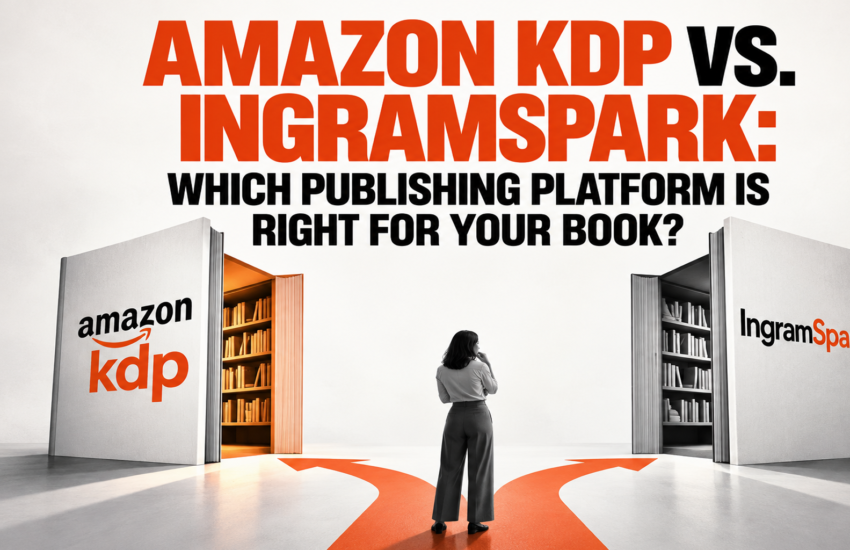
Two names frequently come up in the conversation: Amazon Kindle Direct Publishing (KDP) and IngramSpark.
Both support independent publishing, but their distribution arrangements, production options, and commercial structures differ.
If you’re considering publishing an ebook, paperback, or hardcover, it’s worth understanding how each service fits your goals.
This guide compares Amazon KDP vs. IngramSpark to help you make a more informed publishing decision.
What Is Amazon Kindle Direct Publishing?
Amazon Kindle Direct Publishing, commonly known as KDP, is Amazon’s self-publishing platform.
Eligible authors can use KDP to publish ebooks and supported print formats for sale through Amazon’s marketplace.
KDP provides tools for uploading manuscripts, supplying cover files, setting book details, and selecting available distribution and pricing options.
For many first-time authors, one of its main attractions is the ability to publish without a traditional publishing contract.
However, authors remain responsible for following the platform’s content requirements and understanding its pricing, royalties, and rights terms.
What Is IngramSpark?
IngramSpark is a publishing platform offering print and digital distribution services for independent publishers and eligible authors.
It is particularly associated with print-on-demand production and access to book distribution channels.
Authors can prepare titles for distribution through participating retailers and other eligible channels.
However, distribution availability does not guarantee that a physical bookstore will stock the book.
Retailers make their own purchasing and inventory decisions.
Amazon KDP vs. IngramSpark: Key Differences
| Feature | Amazon KDP | IngramSpark |
|---|---|---|
| Core association | Publishing and selling through Amazon | Publishing and distribution services |
| Ebook publishing | Supported | Available under applicable platform programs |
| Print-on-demand | Supported for eligible formats | Supported for eligible formats |
| Amazon marketplace | Direct integration with Amazon | Availability depends on distribution arrangements |
| Bookstore ordering channels | Platform-specific distribution options | Access through participating wholesale distribution channels |
| Author control | Subject to platform terms | Subject to platform terms |
| Fees and compensation | Depend on format, marketplace, and current policies | Depend on format, distribution terms, and current policies |
Platform capabilities and fees can change. Always verify the current terms directly before making a final decision.
Which Platform Is Better for Selling Books on Amazon?
If Amazon is your primary intended sales channel, KDP may be a straightforward option.
Its publishing tools are designed around Amazon’s environment, including supported Kindle and print formats.
However, authors should review printing specifications, royalty calculations, and marketplace availability before selecting their publishing settings.
The best choice depends on where your readers shop and how you intend to manage distribution.
Which Platform Is Better for Bookstore Distribution?
IngramSpark may appeal to authors seeking distribution access beyond a single retail marketplace.
Its print distribution arrangements can make eligible titles available for ordering through participating retailers.
But ordering availability is not the same as guaranteed shelf placement.
Consider a local bookstore that wants to sell your independently published novel.
The store may evaluate wholesale terms, return arrangements, reader demand, and other commercial factors before deciding whether to order copies.
Understanding these realities helps authors establish more realistic distribution expectations.
Understanding Print-on-Demand Publishing
Print-on-demand allows books to be printed in response to orders rather than requiring authors to purchase a large inventory upfront.
This model can reduce storage requirements and the risk of unsold stock.
However, printing costs affect the amount earned from each sale.
For example, two books with the same retail price may produce different earnings if one has a larger page count, more expensive paper, or color printing.
Before choosing a platform, use the current printing cost and compensation tools provided by that service.
What About ISBNs?
ISBN arrangements can affect how you publish across different platforms.
If you want to use the same paperback edition across multiple distribution services, you should understand whether your ISBN can be used in each arrangement.
Some platforms offer identifiers or ISBN options with usage restrictions.
Authors considering broader control over publisher identification may prefer to obtain their own ISBNs where required.
For US authors, ISBNs can be obtained through Bowker, the country’s designated ISBN agency.
Always check current platform requirements before assigning identifiers or uploading files.
Can Authors Use Both KDP and IngramSpark?
Some authors use more than one distribution platform, especially when they want to manage different print channels.
However, this approach requires careful planning.
You should check for overlapping distribution, ISBN restrictions, duplicate retail listings, pricing inconsistencies, and any relevant program exclusivity rules.
For example, enrolling an eligible ebook in KDP Select involves particular digital exclusivity requirements during the enrollment period.
That requirement should not be confused with a universal restriction on publishing print books elsewhere.
The rules depend on the products and programs involved.
Review the applicable agreements before distributing the same title through multiple services.
How to Choose the Right Platform for Your Book
Start by identifying your primary objectives.
Scenario 1: An author focused on Kindle readers
An author publishing a short nonfiction ebook primarily for Amazon customers might find KDP suitable for the intended sales strategy.
Scenario 2: An author exploring wider print distribution
A nonfiction author who wants bookstores and other participating retailers to be able to order print editions may evaluate IngramSpark’s distribution arrangements.
Scenario 3: An author with multiple formats
An author releasing ebook, paperback, and hardcover editions may compare both platforms and decide whether a combination is appropriate.
In each case, the decision should account for costs, rights, identifiers, supported formats, and distribution goals.
Publishing Support Beyond Platform Selection
Choosing a platform is only one part of publishing a professional book.
Your manuscript still needs appropriate editing, cover design, formatting, and metadata.
Publishing Republic’s book publishing services can be explored by authors seeking assistance with their publishing projects.
Whether you’re preparing an ebook or print title, it helps to define your production and distribution needs before making commitments.
Ready to move toward publication? Contact Publishing Republic to discuss your book publishing requirements.
Frequently Asked Questions
Is Amazon KDP free to use?
KDP offers publishing options without an upfront uploading fee for eligible titles, but sales are subject to applicable pricing, printing, and royalty arrangements.
Does IngramSpark guarantee bookstore placement?
No. Distribution access does not guarantee physical bookstore stocking or sales.
Can I publish the same book on both platforms?
It may be possible under appropriate arrangements, but authors must review ISBN requirements, overlapping distribution, and applicable exclusivity terms.
Which platform pays higher royalties?
There is no universal answer. Compensation depends on the book’s format, price, production cost, marketplace, distribution settings, and current platform terms.
Should I use my own ISBN?
That depends on your publishing strategy. Your own ISBN may provide additional flexibility in certain distribution arrangements, but platform-specific requirements still apply.
Final Thoughts
Amazon KDP and IngramSpark provide different opportunities for independent authors.
KDP is closely integrated with Amazon’s retail ecosystem, while IngramSpark offers distribution arrangements that may support broader print availability.
The right platform depends on your target readers, publishing formats, financial goals, and distribution strategy.
Want professional help preparing your book for publication? Explore Publishing Republic’s book publishing services and discuss your next steps.
