
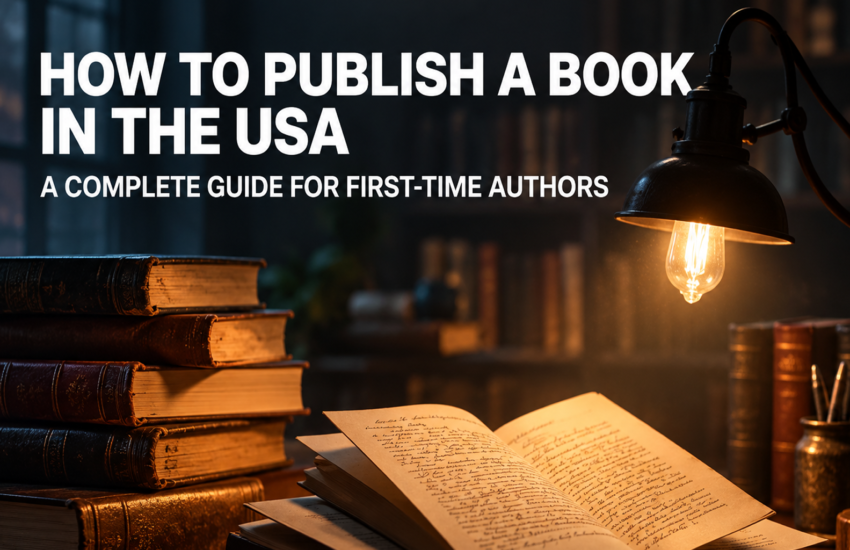
You have spent months, perhaps even years, developing your book idea. Maybe you have finally completed your manuscript, or you’re just beginning to imagine your name on the cover of a published book.
Either way, one question probably comes to mind: How do you publish a book in the USA?
The publishing industry offers more opportunities than ever for authors to reach readers. From traditional publishing houses to independent publishing platforms and professional book publishing services, there are several ways to turn a manuscript into a published title.
However, choosing the right approach requires more than uploading a document and creating a cover.
A successful publishing process involves editorial preparation, design, copyright considerations, distribution decisions, and a plan for reaching readers.
This guide explains the essential steps every aspiring author should understand before publishing a book in the United States.
Step 1: Define Your Book’s Purpose and Target Audience
Before choosing a publisher or publishing platform, think about the readers you want to reach.
Are you creating a nonfiction book for business professionals? A memoir for people who share similar experiences? Or a fiction novel designed to entertain a particular audience?
Understanding your target readership influences almost every publishing decision, including your cover design, book description, pricing, distribution channels, and marketing strategy.
For example, an entrepreneur publishing a practical leadership guide may focus on reaching professionals through speaking engagements, LinkedIn, and business communities.
A fantasy novelist, meanwhile, may prioritize genre-specific communities, ebook retailers, and reader reviews.
Identifying your readers early makes the publishing process more focused.
Step 2: Complete and Refine Your Manuscript
Your manuscript is the foundation of the entire project.
Before publication, review whether your book delivers on its central promise.
For fiction, pay attention to plot development, pacing, character consistency, and narrative structure.
For nonfiction, consider how clearly the information is organized, whether examples support your main ideas, and whether factual claims are accurate.
An unfinished or poorly structured manuscript can make later production stages more difficult.
If you have a strong idea but need help creating the content, professional ghostwriting may be an option. If the manuscript is already complete, editorial support is often the more appropriate next step.
Step 3: Invest in Professional Book Editing
Editing is one of the most important stages of preparing a book for publication.
Even experienced writers benefit from an independent review of their work.
Different editing services address different needs.
Developmental editing focuses on structure, organization, arguments, character development, and overall manuscript quality.
Line editing improves clarity, sentence flow, tone, and readability.
Copyediting addresses grammar, spelling, punctuation, and consistency.
Proofreading helps catch remaining errors after the book has been edited and laid out.
Not every manuscript needs every service at the same level, but authors should understand the differences before making publishing decisions.
Step 4: Choose Between Traditional Publishing and Self-Publishing
One of the biggest decisions aspiring authors face is selecting a publishing route.
Traditional publishing typically involves submitting your manuscript or proposal to agents or publishers, followed by an acquisition process if the book is accepted.
Self-publishing allows authors to arrange production and publication independently or with professional assistance.
Self-publishing often gives authors greater control over design, pricing, and release schedules. However, authors also take responsibility for coordinating services and managing their publishing budgets.
There are also assisted publishing arrangements in which authors hire professionals to help with editing, design, formatting, or distribution.
Before signing any agreement, understand the financial model, services provided, rights ownership, and distribution arrangements.
Step 5: Create a Professional Book Cover
Your cover is often the first part of your book potential readers encounter.
An effective book cover should communicate the genre, tone, and intended audience.
For example, a suspense novel might use dramatic imagery and bold typography, while a business book may benefit from a cleaner, more authoritative visual style.
Good cover design is not simply about making a book attractive.
It is about establishing expectations and helping readers understand what kind of experience the book offers.
Your design should also work at thumbnail size because readers frequently discover books through online retailers.
Step 6: Format Your Book for Print and Digital Publishing
Formatting transforms your manuscript into files suitable for publication.
Print books require decisions about trim size, margins, typography, page numbering, chapter layout, and other production specifications.
Ebooks require digital formatting appropriate for supported reading devices and platforms.
These formats have different technical requirements.
For example, a paperback interior designed for a specific trim size cannot simply be treated as a finished ebook without considering reflowable text and digital navigation.
Proper formatting helps create a more consistent reading experience.
Step 7: Understand ISBNs and Copyright
An International Standard Book Number (ISBN) is an identifier used for particular book editions and formats.
In the United States, authors who need to purchase their own ISBNs can obtain them through the US ISBN agency, Bowker.
Different formats or editions may require separate ISBNs. Some self-publishing platforms also offer ISBN options subject to their own conditions.
Copyright is a separate issue.
Under US law, copyright generally arises when qualifying original expression is fixed in a tangible form. Registration provides additional legal benefits and is worth understanding before publication.
Authors should also verify that they have the necessary rights to any third-party photographs, illustrations, quotations, or other material included in their books.
Step 8: Select Your Book Distribution Channels
Publishing a book is not the same as making it available everywhere.
Distribution determines where readers can discover and purchase your title.
Depending on your publishing strategy, you might consider online retailers, print-on-demand platforms, ebook stores, bookstore distribution channels, or direct sales.
Amazon Kindle Direct Publishing (KDP) is one familiar option for independently publishing ebooks and print books.
Other services, such as IngramSpark, offer different distribution arrangements and print options.
Compare current platform specifications, fees, territorial availability, and rights requirements before choosing a distribution setup.
Step 9: Prepare Your Book Metadata
Book metadata is the information retailers, distributors, and readers use to identify and understand your title.
It includes the book title, subtitle, author name, description, categories, relevant keywords, publication information, and other details.
For example, a nonfiction book about personal finance should have a description that clearly identifies its intended audience and the problems it helps readers understand.
Accurate, relevant metadata makes the book easier to categorize and helps potential buyers decide whether it fits their interests.
Avoid misleading categories, exaggerated claims, or irrelevant keywords.
Step 10: Plan Your Book Launch
A book launch should begin before the publication date.
Consider how potential readers will discover your book.
You may build an author website, create an email list, share useful content, contact relevant communities, or organize promotional activities.
For example, a business author could publish educational articles based on their expertise and use those articles to introduce the upcoming book.
A novelist might share character introductions, behind-the-scenes writing updates, and genre-related content to build reader interest.
The important point is to align your marketing with your actual audience rather than relying on a generic promotional campaign.
How Publishing Republic Can Help You Publish Your Book
Publishing a book involves creative, editorial, technical, and commercial decisions.
Coordinating the process can be challenging, particularly for first-time authors unfamiliar with production requirements and publishing platforms.
Publishing Republic offers book publishing services for authors seeking professional guidance and support with their publishing projects.
Whether you’re preparing a fiction manuscript, nonfiction title, memoir, or business book, discussing your goals can help you understand what services your project requires.
Ready to take the next step? Explore Publishing Republic’s professional book publishing services and discuss your manuscript with the team.
Frequently Asked Questions
Can I publish a book in the USA without a traditional publisher?
Yes. Self-publishing allows authors to publish independently using suitable publishing platforms and professional services.
Do I need an ISBN to publish a book?
The requirement depends on the format and distribution platform. Some ebook platforms do not require authors to supply an ISBN, while print distribution often involves ISBN requirements.
How much does it cost to publish a book in the USA?
Costs vary depending on editing, cover design, formatting, printing, distribution, and marketing requirements.
First-time authors can publish through both traditional and independent routes. Publishing success depends on many factors, including manuscript quality, audience demand, distribution, and marketing.
Do I need a finished manuscript before contacting a publishing company?
Not always. Some publishing services support authors during manuscript development, while others require a completed draft before beginning production.
Final Thoughts
Publishing your first book can be an exciting milestone, but achieving a professional result requires preparation.
From editing and cover design to ISBN decisions, formatting, distribution, and marketing, every stage plays a role in bringing your manuscript to readers.
The best approach is to understand your options, define your goals, and choose services that fit your project.
Your publishing journey starts with a plan. Explore Publishing Republic’s book publishing services and discover the next step for your manuscript.
