


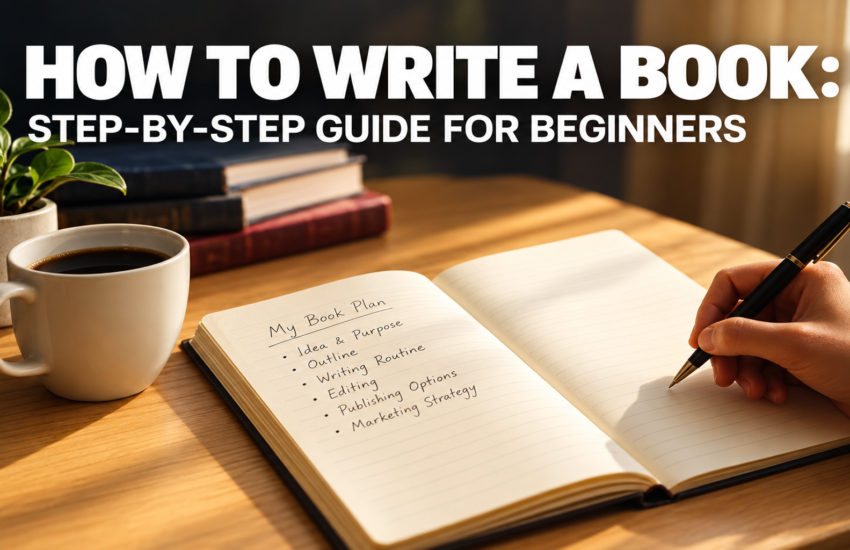
Have you ever dreamed of writing a book but struggled to figure out where to begin?
Perhaps you have a powerful story, valuable professional knowledge, or an imaginative concept that could become a novel. Yet turning an idea into a complete manuscript can feel overwhelming, especially if you’ve never written a book before.
The good news is that becoming an author doesn’t require knowing everything about the writing process from day one.
With a clear plan, realistic goals, and consistent effort, you can develop your ideas into a structured manuscript.
In this beginner-friendly guide, we’ll explain how to write a book, from choosing your concept to preparing your first draft for professional editing.
1. Start With a Clear Book Idea
Every book begins with an idea, but not every idea is ready to become a full manuscript.
Before you start writing, consider what you want your book to communicate.
For fiction, this might involve an interesting character, a compelling conflict, or an unusual setting.
For nonfiction, your idea may center on personal experiences, professional expertise, or information that helps readers understand a topic.
Ask yourself three important questions:
- What is my book about?
- Who would want to read it?
- What makes this story or information worth sharing?
Your answers don’t need to be perfect. Their purpose is to help you identify a clear direction.
For example, instead of writing a general book about entrepreneurship, you might focus on the lessons learned while building a small business with limited resources.
A more focused concept gives your manuscript a stronger foundation.
2. Identify Your Target Readers
Understanding your audience is one of the most useful steps in book writing.
A book written for first-time entrepreneurs should communicate differently from one intended for experienced business executives.
Similarly, a fantasy novel aimed at young adults may use different themes, pacing, and language from a literary novel written for adult readers.
Consider your readers’ interests, expectations, and reasons for choosing a book like yours.
If possible, explore books in the same genre or subject area.
Pay attention to how successful authors structure chapters, introduce ideas, and engage readers.
The goal isn’t to copy another book. It’s to understand the conventions and expectations of your chosen category.
3. Choose the Right Book Genre
Your genre influences your book’s style, content, and structure.
Common fiction genres include romance, thriller, mystery, science fiction, fantasy, and historical fiction.
Nonfiction categories include memoirs, autobiographies, business books, personal development, educational guides, and biographies.
Some book ideas overlap multiple categories.
For example, a fictional story inspired by real experiences remains fiction if events and characters are invented or substantially fictionalized.
Choosing the appropriate category helps you make more consistent writing decisions.
4. Create a Book Outline
An outline acts as a roadmap for your manuscript.
It doesn’t have to be complicated.
For nonfiction, begin by identifying your main topics and arranging them into a logical sequence.
For fiction, consider your central conflict, important characters, major turning points, and possible ending.
A simple outline might include:
Beginning: Introduce the central idea, character, or problem.
Middle: Develop the main themes, challenges, or events.
Ending: Provide a meaningful resolution or conclusion.
Some writers prefer detailed outlines, while others discover their stories during drafting.
Experiment with the approach that helps you maintain momentum.
5. Establish a Realistic Writing Schedule
One of the most common reasons manuscripts remain unfinished is the absence of a consistent writing routine.
You don’t need to write for several hours every day.
Start with a schedule that fits your responsibilities.
For example, writing 500 words during five sessions each week produces 2,500 words.
At that pace, a 50,000-word first draft would require approximately 20 weeks of drafting, excluding planning, revisions, and missed sessions.
This is a mathematical example, not a guaranteed timeline.
Your actual progress will depend on research, complexity, and available time.
Consistency is usually more sustainable than relying on occasional bursts of motivation.
6. Focus on Completing Your First Draft
A first draft is a starting point, not a finished book.
Many new authors struggle because they try to make every sentence perfect while writing.
Constantly revising the opening chapter can prevent you from moving forward.
Instead, focus on developing the manuscript.
If you encounter a difficult section, leave a note about what needs additional research or rewriting.
You can address those issues during revision.
Completing a rough draft gives you something concrete to improve.
7. Develop a Consistent Writing Voice
Your writing voice influences how readers experience your book.
A conversational nonfiction guide may use direct language and practical examples.
A literary novel might use more descriptive prose and a distinctive narrative style.
Whichever approach you choose, aim for consistency.
Read sections aloud to identify awkward sentences, unnatural dialogue, or abrupt changes in tone.
A consistent voice helps the manuscript feel connected from one chapter to the next.
8. Revise and Strengthen Your Manuscript
After completing your first draft, review the manuscript as a whole.
Look beyond grammar and spelling.
Ask whether the opening establishes a clear purpose, whether the chapters follow a logical order, and whether the conclusion delivers a satisfying result.
For fiction, consider character motivations, plot consistency, dialogue, and pacing.
For nonfiction, review the accuracy of information, clarity of explanations, and usefulness of examples.
You may need several revision rounds before the manuscript is ready for professional editing.
9. Consider Professional Book Writing Assistance
Not every aspiring author has the time, confidence, or writing experience required to complete a manuscript independently.
Professional writing assistance can be useful if you’re struggling with structure, organizing your ideas, or developing substantial sections.
Depending on your needs, you might work with a writing coach, editor, collaborator, or ghostwriter.
A ghostwriter can help create manuscript content based on your ideas and direction.
Publishing Republic offers professional ghostwriting services for authors who need support developing their book concepts into written manuscripts.
10. Prepare Your Book for Publication
Completing your manuscript is an important milestone, but publication involves additional decisions.
You may need professional editing, proofreading, cover design, formatting, ISBN arrangements, and distribution planning.
You should also understand the differences between traditional publishing and self-publishing.
Publishing Republic’s book publishing services can help authors explore the professional support they may need after writing.
Frequently Asked Questions
Can I write a book with no experience?
Yes. Many authors begin without professional writing experience. Planning, practice, research, and revision can help develop the skills needed to complete a manuscript.
How many words should my first book have?
Word count varies by genre, audience, and publishing goals. Research comparable books rather than choosing an arbitrary length.
How long does it take to write a book?
The timeline depends on the manuscript’s length, complexity, research requirements, writing schedule, and revision process.
Should I write or outline my book first?
Both approaches can work. An outline provides structure, while exploratory drafting may suit authors who prefer discovering ideas as they write.
Can I hire someone to help write my book?
Yes. Professional writing assistance may include ghostwriting, co-writing, editorial guidance, or writing coaching, depending on your requirements.
Final Thoughts
Learning how to write a book begins with a clear idea, but completing one requires consistent effort and thoughtful planning.
You don’t have to master the entire writing process before starting. Focus on one stage at a time, from developing your concept to completing and revising your manuscript.
Have a book idea but need professional writing support? Contact Publishing Republic to discuss your project and explore the available book writing assistance.
