

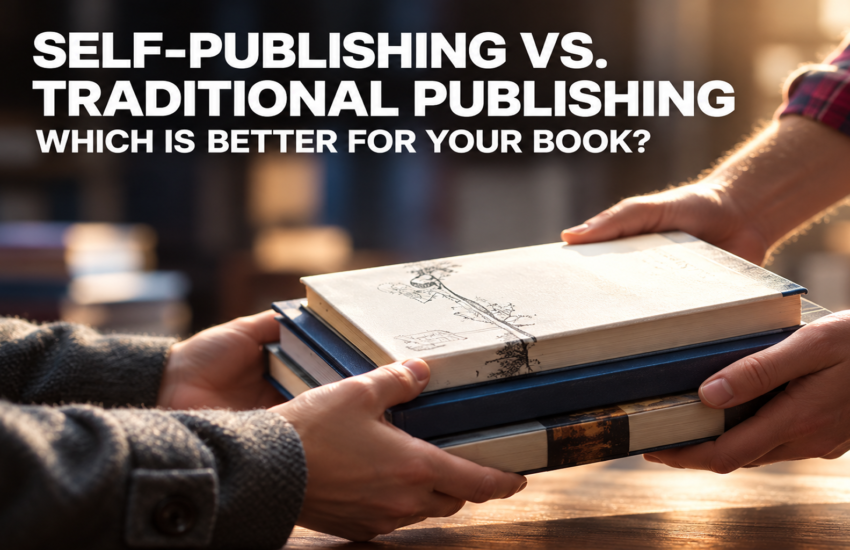
Finishing a manuscript is a significant achievement. But once your book is written, another important decision awaits.
Should you pursue a traditional publishing deal or publish independently?
The debate surrounding self-publishing vs. traditional publishing is particularly relevant to first-time authors who want to understand the opportunities, responsibilities, and financial implications of each route.
Both options can result in professionally produced books, but they involve different levels of creative control, investment, distribution support, and publishing risk.
The best choice depends on your goals, available resources, intended audience, and preferred involvement in the process.
What Is Traditional Publishing?
Traditional publishing usually involves submitting a manuscript or proposal to a literary agent or publishing house.
If a publisher acquires the book, it typically manages and finances agreed publishing activities, which may include editing, cover design, production, distribution, and marketing.
The author enters a contract defining rights, compensation, publication responsibilities, and other conditions.
Some traditional publishing agreements include an advance against royalties, while others may operate without an advance.
Because publishers select books based on editorial and commercial considerations, acceptance is not guaranteed.
The acquisition process can also take considerable time.
What Is Self-Publishing?
Self-publishing allows authors to publish their work independently without relying on a traditional publisher to acquire the manuscript.
Authors can use platforms that support ebook, paperback, or hardcover publication.
They can also hire professional editors, cover designers, formatters, and publishing-service providers to assist with production.
This gives authors greater responsibility for creative decisions, costs, distribution choices, and promotional activities.
For example, a consultant writing a specialised business book might prefer self-publishing because they want to control the release date and use the book in their professional work.
An aspiring literary novelist, by contrast, may prefer to pursue an agent and traditional publishing agreement.
Neither approach is universally better.
Self-Publishing vs. Traditional Publishing: Key Differences
| Factor | Self-Publishing | Traditional Publishing |
|---|---|---|
| Publishing decision | Author decides when to publish | Publisher must acquire the work |
| Upfront production expenses | Generally author-funded | Generally publisher-funded |
| Creative control | Usually greater author control | Shared or contractually limited |
| Publishing timeline | Influenced by author and production schedule | Influenced by acquisition and publisher schedule |
| Distribution | Chosen and arranged by the author or service provider | Arranged under the publishing agreement |
| Compensation | Platform revenue after applicable costs and deductions | Contractual royalties and possible advance |
| Marketing responsibility | Largely author-directed | Varies by publisher and contract |
| Rights | Depends on selected platforms and agreements | Defined by publishing contract |
Which Option Offers More Creative Control?
Self-publishing generally allows authors to make more decisions about their books.
You may choose the cover direction, publication schedule, pricing strategy, and distribution channels.
However, freedom also brings responsibility.
If a cover doesn’t meet reader expectations or a manuscript contains avoidable errors, those problems can affect how readers perceive your work.
Traditional publishing often involves collaboration with an editorial and production team.
The publisher may have contractual authority over important publishing decisions, although the exact terms vary.
If creative independence is a major priority, self-publishing may be appealing.
Which Publishing Route Costs More?
Traditional publishers generally fund the production of books they acquire.
Self-publishing authors typically finance the services they choose to purchase.
However, comparing only upfront expenses doesn’t tell the full story.
Self-publishing authors should consider editing, formatting, cover design, distribution deductions, and marketing costs.
Traditional publishing authors should review the compensation terms, rights granted to the publisher, royalty calculations, and potential future earnings.
An apparently attractive agreement can have important long-term implications if it grants extensive rights.
Which Option Helps Authors Publish Faster?
Self-publishing often provides greater scheduling flexibility because the author does not need to wait for a publishing house to acquire the manuscript.
However, professional production still requires time.
Editing, cover design, formatting, proof review, and distribution setup cannot always be completed immediately.
Traditional publishing generally involves additional stages such as agent submissions, acquisition decisions, contract negotiation, and publisher scheduling.
The appropriate timeline depends on the author’s priorities.
If you need a book ready for a planned professional event, independent publishing may offer more control over scheduling.
What About Book Royalties?
Royalty structures differ significantly between publishing models.
Self-publishing platforms typically compensate authors based on sales revenue after specified deductions, which can include platform fees and printing costs.
Traditional publishers pay authors according to contractual terms and may recoup an advance before additional royalties become payable.
Importantly, a higher royalty percentage does not automatically lead to greater total earnings.
Sales volume, pricing, distribution, production costs, and marketing all influence the outcome.
Authors should compare financial terms based on realistic scenarios rather than headline percentages alone.
What Is Assisted Self-Publishing?
Assisted self-publishing involves hiring professionals to help with some or all of the publishing process while the author follows an independent publication route.
For example, an author may hire a service provider to coordinate editing, cover design, formatting, and technical preparation.
This can be useful for someone who wants to self-publish but doesn’t want to manage every production detail.
However, service packages and contracts vary.
Before hiring a provider, verify the deliverables, rights ownership, ISBN arrangements, distribution setup, and ongoing fees.
Also distinguish a paid service provider from a traditional publisher acquiring and financing your work.
How Do You Choose the Right Publishing Route?
Imagine two authors preparing very different books.
Author A: A business consultant
The consultant wants to publish a practical guide for clients and use it at workshops. They have a specific release date and want control over pricing and branding.
Assisted self-publishing may fit those requirements.
Author B: A novelist seeking a traditional publishing career
The novelist is comfortable with an uncertain submission timeline and wants to pursue literary representation and traditional publisher distribution.
Seeking a traditional deal may fit their priorities.
Both approaches can be reasonable because the authors have different goals.
The best publishing route is the one aligned with what you want your book to accomplish.
Explore Your Book Publishing Options With Publishing Republic
Choosing a publishing route involves many practical considerations.
If you’re considering independent publication and want assistance with the process, understanding the available professional services can help.
Publishing Republic offers book publishing services for authors exploring how to prepare and release their books.
Discuss your goals, manuscript condition, and publishing expectations before selecting a service package.
Ready to explore your publishing options? Contact Publishing Republic to discuss your book project and the next steps.
Frequently Asked Questions
Is self-publishing better than traditional publishing?
Neither option is better for every author. Self-publishing offers greater scheduling and creative flexibility, while traditional publishing provides a different financial and distribution model.
Can self-published books become successful?
Yes, but success is not guaranteed. Outcomes depend on factors such as book quality, reader demand, discoverability, pricing, and marketing.
Legitimate traditional publishers generally finance the production of books they acquire rather than charging authors for standard publication services. Paid publishing arrangements follow a different model.
Can I use professional services and still self-publish?
Yes. Authors can hire editors, designers, formatters, and publishing consultants while remaining responsible for their independent publishing decisions.
Can I switch from self-publishing to traditional publishing later?
Possibly, but existing publication history, rights agreements, distribution arrangements, and publisher interest can affect future options.
Final Thoughts
The decision between traditional publishing and self-publishing should begin with your objectives, not assumptions about which route is more prestigious or profitable.
Traditional publishing may suit authors seeking an acquisition-based relationship with a publishing house.
Self-publishing may suit authors who value independent decision-making and are prepared to manage or outsource production responsibilities.
Whichever route you choose, understanding the process and your contractual rights is essential.
Have a manuscript ready to publish? Explore Publishing Republic’s professional book publishing services and take the next step toward publication.
